Think about the last product you actually loved using. Maybe it was a water bottle that never leaked, a chair that felt right the moment you sat in it, or a tool that just made sense in your hand. Someone designed that. They decided the grip angle, the material, the weight, the way it opens. That person is a product designer and it is one of the most in-demand creative professions in India right now.
The B.Design in Product Design in Anand at CVM University School of Design is built for students who want to be that person. Not just the one with the idea, but the one who knows how to take it from a rough sketch all the way to a manufacturable, market-ready object.
If you are finishing Class 12 and wondering whether a design degree makes practical sense in 2026, the short answer is yes and this blog will show you exactly why.
Why Product Design Is the Right Career Choice in 2026
Here is something most career counsellors do not tell students clearly enough: India is not just a manufacturing country anymore. It is becoming a design country.
For decades, Indian factories made products designed elsewhere. That is changing fast. Companies like Godrej, Bajaj, Tata, and dozens of mid-sized Gujarat manufacturers are now building internal design teams because they want to own the look, feel, and experience of what they sell not just the production line.
At the same time, India’s startup ecosystem has created thousands of new consumer brands in furniture, personal care, kitchen appliances, baby products, fitness equipment, and more. Every single one of those brands needs a product designer. Someone who can figure out what a product should do, how it should look, what it should be made of, and how it should feel in the hands of a real person.
The National Design Policy, updated in recent years, has pushed design education further into focus and companies that once saw design as optional now treat it as a core business function.
For a student in central Gujarat, this is not abstract. The region around Anand has a dense base of SME manufacturers, dairy equipment suppliers, agricultural tool makers, and FMCG producers and they are all beginning to compete on design, not just on price. Studying a B.Design in Product Design in Anand puts you in the middle of that shift, not watching it from the outside.
What Is B.Design in Product Design, Really?
B.Design stands for Bachelor of Design. It is a four-year undergraduate degree recognized by the UGC, and the Product Design specialization is specifically about physical objects how they are conceived, shaped, tested, refined, and brought to production.
It is worth being clear about what this degree is and is not. It is not a fine arts degree where the goal is self-expression. It is not a mechanical engineering degree where everything is load calculations and stress tolerances. It sits deliberately between those two worlds.
A product designer thinks about the user first. Who is going to use this? In what context? What do they find frustrating about the current solution? What would feel intuitive? Then they bring in material knowledge, manufacturing logic, and visual sensibility to create something that is not just beautiful, but genuinely useful and producible at scale.
By the end of a B.Design in Product Design program, you should be able to do all of that and show it through a professional portfolio that demonstrates your thinking, not just your output.
B.Design in Product Design at CVM University School of Design Program Overview
CVM University School of Design in Anand approaches design education through a studio-first model. That means less time sitting in lectures and more time actually making things building physical models, running user research sessions, working on live briefs, and presenting work to peers and industry guests.
| Program Detail | Information |
|---|---|
| Program Name | B.Design in Product Design |
| University | CVM University School of Design |
| Location | Anand, Gujarat |
| Duration | 4 Years (8 Semesters) |
| Mode | Full-Time, Studio-Based |
| Eligibility | 10+2 any stream, minimum 50% marks |
| Admission Process | Aptitude test and/or portfolio review |
| Recognition | UGC Recognized University |
| Website | cvmschoolofdesign.com |
The program is structured so that the first year builds foundations drawing, observation, design thinking, and material awareness before students progressively take on more complex projects. By the third and fourth year, students at CVM University School of Design work on thesis projects and industry-connected briefs that form the core of their graduation portfolio.
Subjects and Skills You Will Actually Build
The curriculum is where things get specific. Here is what the four years actually cover, and why each area matters for your career:
Design fundamentals and sketching form the base of everything. You learn to communicate ideas visually quickly, clearly, and in a way that others can respond to. This skill sounds basic but it separates designers who can lead a conversation from those who cannot.
Material science and manufacturing processes teach you what is actually possible in the real world. You learn the difference between injection-moulded plastic and die-cast aluminium, when to use one over the other, and how the choice affects both cost and user experience. Without this, your designs exist only on screen.
Computer-aided design using tools like SolidWorks, Rhinoceros 3D, and AutoCAD allows you to build precise 3D models of your designs that can be sent directly to a manufacturer or a 3D printer. KeyShot and similar rendering tools let you present photorealistic visuals of products that do not yet physically exist.
Ergonomics and human factors is the science of designing for the human body. How far can a wrist comfortably rotate? What is the average hand grip diameter? How do people interact with a product in low light? These questions directly shape better design decisions.
Prototyping and model making both physical and digital gives you the ability to test your ideas at a low cost before they go into production. Foam, wood, thermocol, 3D-printed parts, and laser-cut components all become tools in your hands.
User research and design thinking methodology teaches you how to conduct interviews, build personas, map user journeys, and frame design problems correctly from the start. Getting this wrong at the beginning costs enormous effort to fix later.
Sustainability in design has moved from a bonus to an expectation. You learn to select materials that can be recycled, design products that can be disassembled, and think about the environmental footprint of what you create because clients and consumers increasingly demand it.
Packaging design, branding and product identity, and design history and theory round out the academic picture, ensuring that graduates understand how products exist within broader commercial and cultural contexts.
Career Opportunities After B.Design in Product Design
The range of industries that hire product design graduates is wider than most students expect when they start the program.
The most direct path is a role as a Product Designer or Industrial Designer at a manufacturing company, consumer brand, or design consultancy. In these roles, you typically work as part of a small team, taking on projects from brief to final specification.
Packaging Design is a significant industry in India, and product design graduates with an understanding of materials and 3D form are well-suited for it. Furniture Design, Automotive Interior Design, and Medical Device Design are specialized tracks that some graduates move into after a few years of general experience.
Design Consultancies firms like Idiom Design, Elephant Design, Desmania, and Onio Design hire B.Design graduates regularly and expose them to projects across multiple industries in quick succession, which builds a diverse portfolio fast.
Many graduates also move into UX Design for physical-digital products smart home devices, wearables, and connected appliances where the ability to think about both the physical and digital interface is a genuine differentiator.
On the startup side, product design graduates who can handle both the visual and technical side of product development are increasingly sought after as founding team members or early hires.
Top recruiters for product design graduates in India include Godrej, Tata Motors Design Studio, Bajaj Auto, Bosch India, Philips Innovation Campus, Asian Paints, Pidilite, Usha International, and several mid-sized Gujarat-based manufacturers who are quietly building design functions for the first time.
Salary Growth in Product Design
Salary in this field is tied closely to portfolio quality and tool proficiency rather than just years of experience. A graduate with a strong portfolio and SolidWorks certification can command a better starting offer than someone with average work and two years of experience.
| Career Stage | Experience | Approximate Salary Range |
|---|---|---|
| Entry Level | 0–2 years | Rs. 2.5 LPA to Rs. 5 LPA |
| Mid Level | 3–6 years | Rs. 5 LPA to Rs. 12 LPA |
| Senior Level | 7+ years | Rs. 12 LPA to Rs. 25 LPA and above |
Automotive, medical devices, and consumer electronics tend to offer the higher end of these ranges. Design consultancies sometimes offer slightly lower base salaries but provide faster portfolio growth, which pays off in the medium term. Freelance designers with strong client networks often earn above these figures once they are three to four years into their career.
Salary growth also depends on whether you pick up additional skills in sustainable design, UX research, or design management each of which opens a different ceiling.
Why Anand Is Actually a Smart Place to Study Product Design Right Now
Students sometimes assume that you need to be in Mumbai, Pune, or Bengaluru to get a serious design education. That assumption is worth questioning.
Anand and the central Gujarat corridor covering Nadiad, Vallabh Vidyanagar, Kheda, and nearby areas has a manufacturing base that most design students in metros never get to interact with during their degree. Dairy equipment, agricultural tools, chemical processing components, FMCG packaging, and light industrial products are all produced here. Studying product design in this environment means your understanding of manufacturing is grounded in real proximity to factories, not just case studies.
CVM University School of Design is embedded in this context. The university’s location gives students access to industry interaction that is qualitatively different from what you get in a large metro design school, where industry relationships are often mediated through agencies and formal tie-ups rather than direct access.
For students from Anand, Nadiad, Kheda, Vallabh Vidyanagar, Karamsad, and surrounding towns, there is also the practical reality of cost. Studying locally removes accommodation and relocation expenses without compromising on the quality of a UGC recognized design degree.
Admission 2026 Eligibility and How to Apply
To be eligible for the B.Design in Product Design at CVM University School of Design, you need to have completed 10+2 from any recognized board Science, Commerce, or Arts with a minimum of 50% aggregate marks. Students appearing in their 2026 board exams can apply provisionally.
The admission process typically includes a design aptitude assessment and a personal interview. You do not need prior formal design training to appear, but familiarity with drawing, observation, and visual problem-solving will help you perform better in the aptitude component.
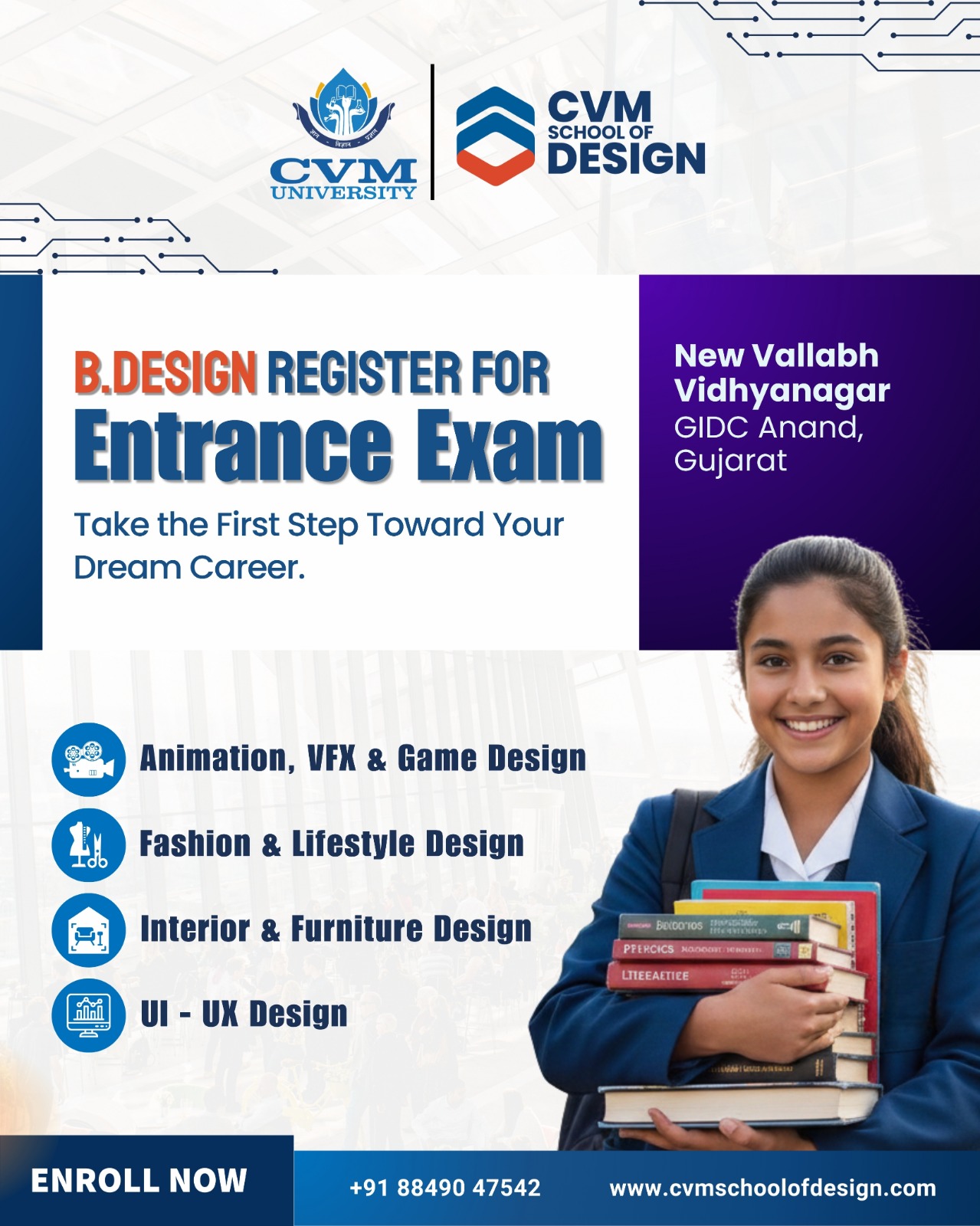
Applications for the 2026 intake are open. Visit cvmschoolofdesign.com to fill out the form and check for any upcoming aptitude test dates. Apply early seats in design programs fill before the deadline more often than students expect.
Frequently Asked Questions
Q1. Do I need a Science background to apply for B.Design in Product Design in Anand?
No. The program is open to students from Science, Commerce, and Arts streams. What matters more than your subject background is your interest in visual problem-solving, how things are made, and how people interact with objects.
Q2. What software will I learn during the B.Design program at CVM University School of Design?
The curriculum includes SolidWorks, Rhinoceros 3D, AutoCAD, KeyShot, and Adobe Illustrator as core tools. Physical prototyping using 3D printers, laser cutters, and workshop equipment is also part of the program, not optional.
Q3. Is product design a stable career in India or is it unpredictable?
Product design is more stable than people assume. Physical product appliances, packaging, tools, vehicles, furniture will always need to be designed. The industry is growing in India as local brands shift from price competition to design-led differentiation, which means consistent demand for trained designers.
Q4. What is the difference between product design and graphic design?
Graphic design deals with visual communication logos, layouts, digital interfaces, and print. Product design deals with physical three-dimensional objects. There is some overlap in areas like packaging, but the core skills, tools, and career paths are quite different.
Q5. Can I start my own business after a B.Design in Product Design?
Yes, and many graduates do. Some open independent design studios and take on projects from manufacturers and startups. Others develop their own product ideas and launch them through e-commerce platforms. The degree gives you both the creative and technical foundation to do either.
Q6. How does the portfolio from CVM University School of Design’s program help in getting hired?
Portfolio quality is the primary hiring criterion in design, ahead of grades. CVM University School of Design’s studio-based model is specifically designed to ensure that students graduate with a portfolio of real project work rather than academic exercises. This is what gets you through the door at design consultancies and product companies.
Q7. Are there postgraduate options after B.Design in Product Design?
Yes. B.Design graduates are eligible to apply for M.Design programs at NID Ahmedabad, IIT Bombay, IIT Delhi, and various private institutions. International programs in product design, design management, and UX design also accept B.Design as a qualifying degree.
Conclusion
Product design is one of those careers where you can see the results of your work in the physical world in stores, in homes, in offices, in people’s hands. If that kind of tangible impact matters to you, then a B.Design in Product Design in Anand at CVM University School of Design is worth taking seriously.
The program gives you real tools, real industry context, and a portfolio that speaks for itself by the time you graduate. The region gives you proximity to manufacturing that most design students never get. And the career options on the other side are broader and more stable than they have ever been in India.
Start your application for the 2026 intake at cvmschoolofdesign.com or reach out to the admissions team through the contact details listed on the website.