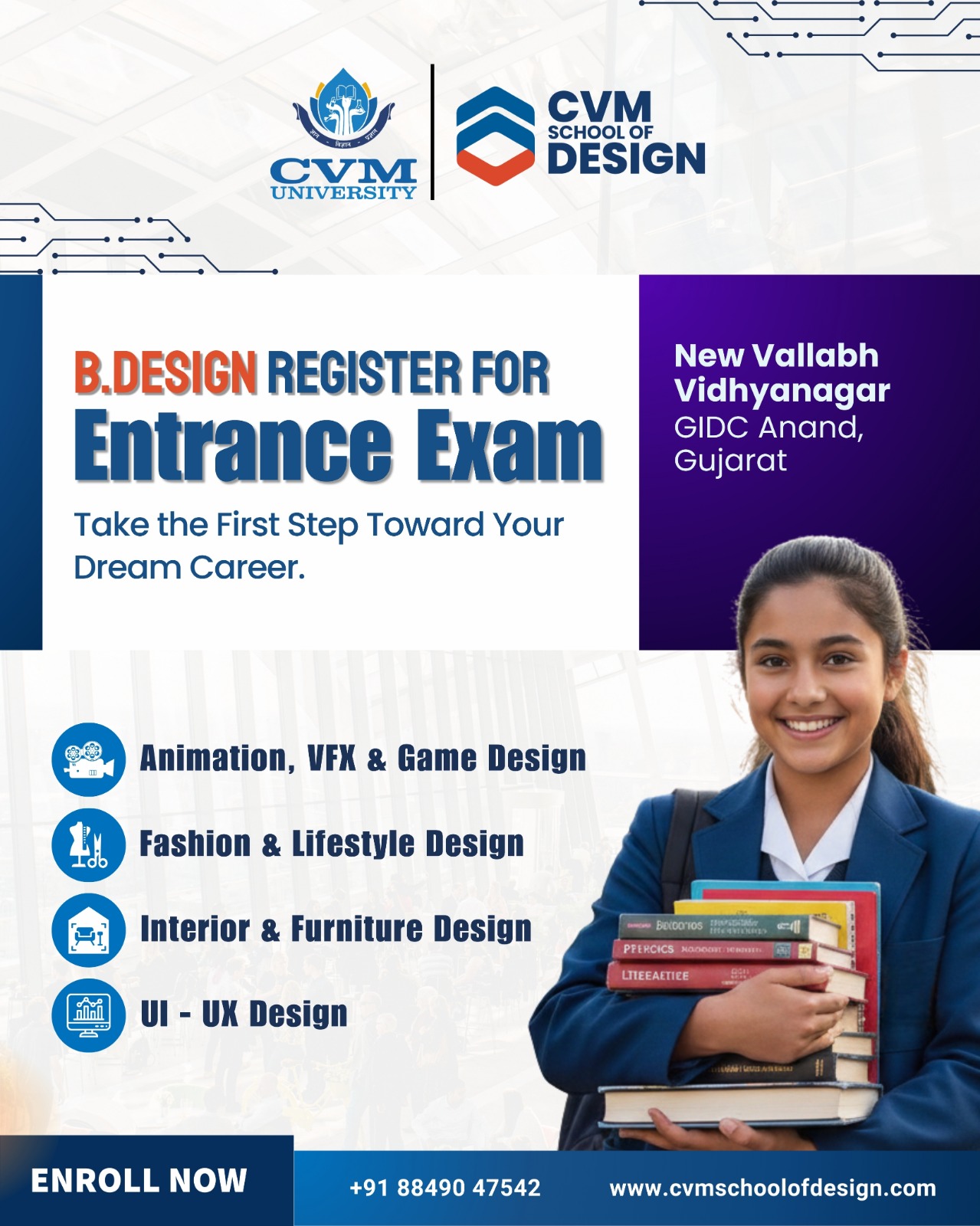


If you are passionate about storytelling through visuals, motion, and interactive worlds, a Master of Design in Animation, VFX and Game Design is one of the most strategically relevant postgraduate degrees you can pursue in 2026. India’s animation and gaming sector is projected to reach $6 billion by 2028, and trained design professionals with a master’s-level foundation are in short supply. CVM University School of Design, located in Anand, Gujarat, offers a rigorous, industry-integrated program that equips students with the technical depth and creative vision required to lead in this space. Whether you see yourself directing visual effects for a streaming production, designing a mobile game, or leading a motion graphics studio, this program builds the skills that studios and employers are actively hiring for.
Why Animation, VFX and Game Design Is the Right Career Choice in 2026
The convergence of OTT platforms, gaming, augmented reality, and immersive media has permanently changed how entertainment and communication are produced. India alone added over 400 new animation studios between 2020 and 2025, and global studios are increasingly outsourcing high-quality VFX work to Indian talent pools. The game design sector is growing even faster with mobile gaming revenues in India crossing $2.8 billion annually, studios need designers who understand not just tools but the full pipeline from concept art to deployment.
This shift has moved animation, VFX, and game design from niche creative fields into mainstream, high-demand professions. Postgraduate programs in these areas are particularly valuable because they develop both craft and strategy helping graduates move into senior production roles significantly faster than those who enter with only a bachelor’s credential.
Additionally, the rise of AI-assisted animation tools, real-time rendering engines like Unreal Engine, and cloud-based VFX pipelines means that professionals who receive master’s-level training in these technologies have a clear edge in the job market.
What Is a Master of Design in Animation, VFX and Game Design?
A Master of Design (M.Des) in Animation, VFX and Game Design is a postgraduate professional degree that combines advanced design theory with hands-on technical training across three closely connected creative disciplines. Animation covers the principles of motion, character rigging, and storytelling. Visual Effects (VFX) focuses on compositing, simulation, and the integration of computer-generated imagery into live-action footage. Game Design encompasses level design, game mechanics, interaction design, environment art, and the production pipelines specific to interactive media.
Unlike undergraduate programs that introduce these subjects broadly, a master’s program expects students to develop a defined specialization while building cross-disciplinary competence. Students typically work on industry-scale projects, build professional portfolios, and engage with mentors who are active practitioners in production studios.
The degree is ideal for graduates of design, fine arts, architecture, computer applications, or multimedia and for working professionals looking to move into senior creative or technical roles.
Master of Design in Animation, VFX and Game Design at CVM University School of Design Program Overview
CVM University School of Design has designed this program to meet the actual demands of India’s production industry. The curriculum integrates studio practice with research-led design thinking, preparing graduates for roles across entertainment, advertising, education technology, and interactive media.
| Program Detail | Information |
|---|---|
| Program Name | Master of Design in Animation, VFX and Game Design |
| Degree Awarded | M.Des |
| Duration | 2 Years (4 Semesters) |
| Program Type | Full-Time |
| University | CVM University School of Design |
| Location | Anand, Gujarat |
| University Recognition | UGC Recognized |
| Admission Cycle | 2026–27 Open |
| Website | cvmschoolofdesign.com |
The program at CVM University School of Design is structured to give students progressive exposure beginning with foundational principles and moving toward advanced production workflows, independent project work, and a final thesis or industry project. Faculty bring direct studio experience, which means the learning environment reflects current production standards rather than outdated academic frameworks.
Subjects and Skills Covered
The curriculum spans both conceptual and technical ground, ensuring graduates can function across creative and production roles. Core areas of study include:
Animation: Principles of animation, character design and rigging, 2D and 3D animation production, motion graphics, storyboarding, and narrative design.
Visual Effects: Compositing fundamentals, particle systems, fluid and cloth simulation, matchmoving, green screen and rotoscopy techniques, and cinematic VFX pipelines using industry tools.
Game Design: Game mechanics and systems design, level design, environment art and world-building, user experience in interactive media, prototyping, and game engine workflows.
Technical Tools Covered:
- Autodesk Maya and 3ds Max for 3D modeling and animation
- Adobe After Effects and Nuke for compositing and VFX
- Unreal Engine and Unity for real-time game development
- ZBrush for sculpting and character design
- Houdini for procedural VFX and simulation
- Adobe Creative Suite for motion graphics and 2D work
- Substance Painter for texturing and material design
Additional Skill Development:
- Production pipeline management
- Pre-production documentation and concept development
- Portfolio building and professional presentation
- Research methodology in design practice
- Collaboration in multi-disciplinary studio environments
Career Opportunities After Master of Design in Animation, VFX and Game Design
Graduates from this program are equipped for a wide range of roles across the entertainment, gaming, advertising, and technology sectors.
Key Job Roles:
- VFX Artist and Compositor
- 3D Animator and Character Animator
- Game Designer and Level Designer
- Technical Director (Animation or VFX)
- Motion Graphics Designer
- Environment and Concept Artist
- Rigging Artist
- Art Director in Gaming or Film Production
- Visual Development Artist
- Freelance Animator or VFX Supervisor
Industries That Hire These Graduates:
The primary hiring sectors include film and OTT production studios, gaming companies, advertising agencies, ed-tech platforms, broadcast media, architectural visualization firms, and virtual reality startups.
Notable Recruiters in India’s Animation and Gaming Sector:
Technicolor, Prime Focus Technologies, Tata Elxsi, Rockstar Games India, Nazara Technologies, DQ Entertainment, Assemblage Entertainment, Xentrix Studios, and leading in-house studios at major OTT platforms.
Salary Growth After an M.Des in Animation, VFX and Game Design
Compensation in this field varies significantly based on specialization, the tools a professional masters, and the sector they enter. Below is a realistic salary reference based on current industry data.
| Experience Level | Years of Experience | Estimated CTC Range |
|---|---|---|
| Entry Level | 0 to 2 years | Rs. 3.5 LPA to Rs. 6 LPA |
| Mid Level | 3 to 6 years | Rs. 7 LPA to Rs. 14 LPA |
| Senior Level | 7 years and above | Rs. 16 LPA to Rs. 30 LPA and above |
Salary growth in this field is strongly tied to portfolio quality, specialization depth, and command of advanced tools such as Houdini, Nuke, or Unreal Engine. Professionals who add certifications in real-time rendering, game production, or VFX supervision tend to move into senior compensation brackets faster. Freelance and international project income can vary considerably beyond these ranges.
Why Anand, Gujarat Students Should Consider This Program Now
Gujarat has emerged as one of India’s most dynamic states for creative and technology education, and Anand in particular benefits from its proximity to Ahmedabad one of the fastest-growing cities for design, digital media, and startup activity in western India.
Students studying at CVM University School of Design in Anand gain access to an academic environment that combines the institutional depth of a UGC-recognized university with a location that is both affordable and well-connected. Ahmedabad hosts a growing number of animation studios, creative agencies, and gaming startups, many of which actively seek graduates from institutions in the wider Gujarat region for internships and full-time roles.
Beyond professional proximity, studying in Anand means lower living costs compared to metros, a focused academic environment, and access to a university that has built a reputation for design education rooted in real-world practice. For students from Gujarat and neighboring states like Rajasthan, Maharashtra, and Madhya Pradesh, this makes CVM University School of Design a practical, high-value choice for postgraduate design education.
Admission 2026 Eligibility and How to Apply
Eligibility Criteria:
Applicants must hold a bachelor’s degree in a relevant discipline. Accepted backgrounds include B.Des, B.F.A., B.Sc. in Multimedia or Animation, B.C.A., B.Arch, or any undergraduate degree with a demonstrable background in design, arts, or media. Final-year students awaiting their results may apply provisionally.
Selection Process:
Admission typically involves a portfolio review, a design aptitude assessment or entrance test, and a personal interview. The portfolio review is a central part of the process — applicants should present work that demonstrates creative thinking, technical capability, or both.
How to Apply:
Visit the official website at cvmschoolofdesign.com to access the application form, review the detailed eligibility criteria, and check the current application deadlines for the 2026–27 academic year. You may also reach the admissions team directly through the contact details listed on the website.
Frequently Asked Questions
Q1. What is the duration of the Master of Design in Animation, VFX and Game Design at CVM University School of Design?
The program is a two-year full-time course structured across four semesters, combining studio coursework, software labs, industry projects, and a final thesis or capstone project.
Q2. Who is eligible to apply for this M.Des program?
Any graduate with a bachelor’s degree in design, fine arts, multimedia, computer applications, architecture, or a related field is eligible to apply. Students in their final undergraduate year may also apply provisionally.
Q3. What software tools will I learn during this program?
Students work with industry-standard tools including Autodesk Maya, Houdini, Nuke, Adobe After Effects, Unreal Engine, Unity, ZBrush, Substance Painter, and the full Adobe Creative Suite, depending on their area of focus.
Q4. What career options are available after completing this degree?
Graduates can pursue roles as VFX artists, 3D animators, game designers, motion graphics designers, art directors, technical directors, or concept artists across film, gaming, advertising, and digital media industries.
Q5. Is the M.Des from CVM University School of Design recognized by UGC?
Yes. CVM University is a UGC-recognized university, and the degrees awarded, including the Master of Design programs, carry the recognition and academic standing that comes with that status.
Q6. What is the scope of animation and game design in India for 2026 and beyond?
India’s animation, VFX, and gaming industry is one of the highest-growth segments in the creative economy. With increasing demand from OTT platforms, mobile gaming, and international co-productions, skilled M.Des graduates in this field have strong and expanding employment prospects over the next decade.
Conclusion
The creative economy in India is accelerating, and professionals with a Master of Design in Animation, VFX and Game Design are positioned at the centre of this growth. Whether you want to build cinematic visual effects, design the next major mobile game, or direct animated content for global audiences, the right postgraduate foundation makes a measurable difference in how far and how fast your career advances. CVM University School of Design in Anand offers a program built around that ambition rigorous, industry-connected, and designed for the realities of 2026 and beyond.
To learn more about admissions, the curriculum, and portfolio requirements, visit cvmschoolofdesign.com or contact the admissions office directly through the website.